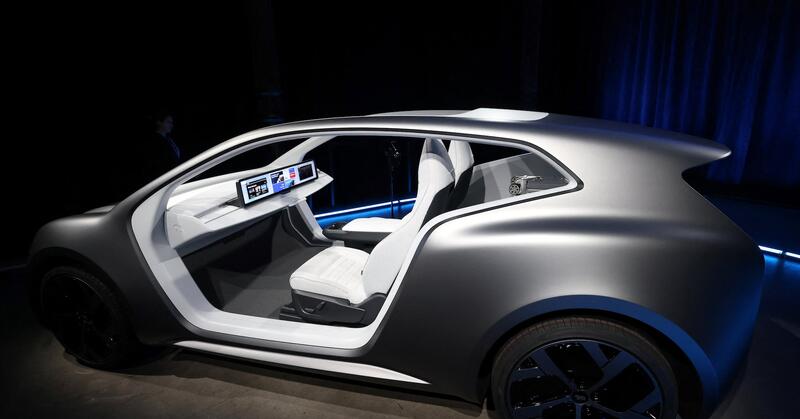
Lucid Group used an investor event in New York to outline a long-term plan to reach positive cash flow late this decade—anchored on a cheaper, higher-volume vehicle platform and a deeper move into autonomy. The headline reveal was a two-seat robotaxi concept—called “Lunar” in related coverage—designed for fully driverless operation, notably without a steering wheel or pedals, signaling Lucid’s intent to compete in the emerging robotaxi market.
Lucid’s strategy has two parallel tracks. First, it wants to broaden beyond luxury (where it is known for the Air sedan and Gravity SUV) by launching a new mid-size EV platform later this year, with a target of boosting annual deliveries to around 100,000 vehicles in the medium term. Second, it wants to monetize autonomous-driving capability through software—an approach that mirrors how other EV makers are trying to turn cars into recurring-revenue platforms.
On autonomy, Lucid announced it will offer self-driving technology via subscriptions, with pricing reported in a range of roughly $69 to $199 per month. The idea is that driver-assistance and autonomy features can become a predictable revenue stream—especially important for an EV company that still faces large upfront costs for manufacturing and expansion. This would put Lucid in more direct competition with Tesla and others that are also charging recurring fees for advanced driver-assistance packages.
Lucid is also positioning itself as an autonomy partner rather than only a carmaker. In fact, the company is working with Uber and Nuro to deploy Lucid-based robotaxis—specifically referencing a robotaxi service built on the Gravity SUV platform. An Uber press release around that partnership has said autonomous road testing began in late 2025 and that the companies are targeting a launch later in 2026, showing Lucid’s robotaxi push includes both a near-term commercial program (Gravity-based) and a longer-term purpose-built concept.
Despite the ambitious roadmap, investors were not immediately convinced. Seemingly, Lucid shares fell sharply (around 8%) after the announcements, reflecting concerns about execution risk and near-term financial pressure. The company is operating in a tougher environment: EV demand growth has slowed in some markets, supply chains remain sensitive, and U.S. tariffs and macro uncertainty can raise costs and complicate planning.
Lucid’s plan to bridge that gap includes aggressive cost improvements. Apparently, it aims to cut unit costs by roughly 50% to 60% and to reduce capital spending as a share of revenue by 2028—targets meant to make the move into mid-priced vehicles economically viable.
Overall, Lucid’s robotaxi concept and subscription autonomy pitch are meant to tell a single story: the company wants to transition from a low-volume luxury EV maker into a scaled, software-enabled mobility platform. Whether it can pull that off—shipping a sub-$50,000 midsize lineup, expanding production efficiently, and proving real-world autonomous capability—will determine if the “robotaxi + subscriptions” strategy becomes a growth engine or just another expensive ambition in the EV race.