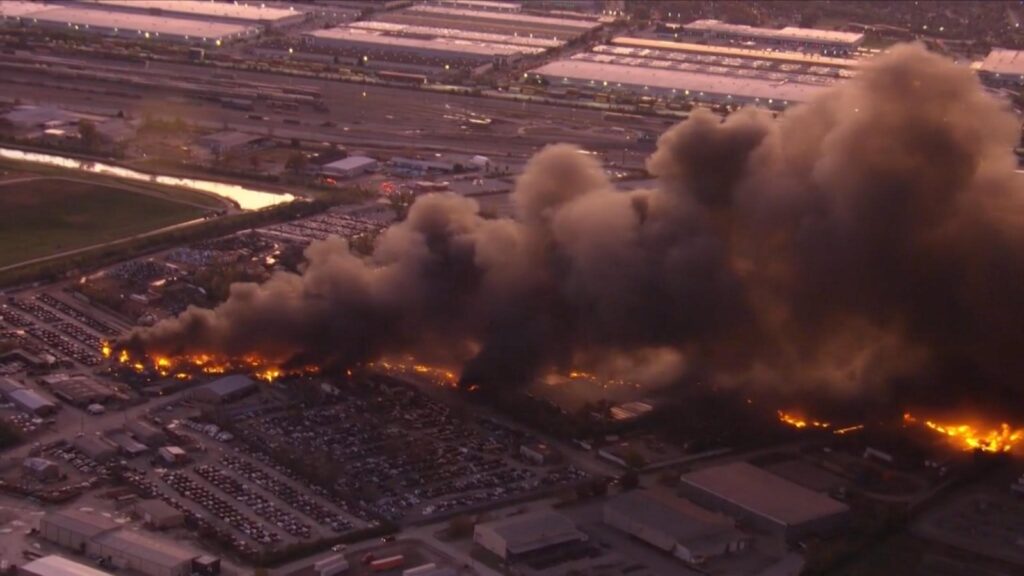
Federal investigators are examining a rare and catastrophic mechanical failure after a UPS MD-11 cargo aircraft crashed shortly after takeoff in Louisville, Kentucky, killing 14 people — three crew members and 11 individuals on the ground.
According to preliminary findings, the aircraft’s left engine detached from the wing during rotation, just seconds after pilots applied full power for takeoff on Runway 17R. Surveillance footage shows the engine, still attached to its pylon, rising over the fuselage while engulfed in flames before falling to the ground near the runway. The jet, struggling to climb more than 30–100 feet, lost control and crashed within moments.
The National Transportation Safety Board (NTSB) confirmed that investigators have found fatigue cracks in the aft mount of the engine pylon, including fractures in the front and rear lugs and damage to the spherical bearing — a structural failure believed to have triggered the mid-air separation. The MD-11 had undergone its last major inspection in October 2021 and still had 7,000 cycles before its next mandatory structural check.
Expert: “There was nothing the crew could have done”
Aviation expert and wide-body jet pilot Marco Bernasconi, who has flown heavy aircraft across Africa, Europe, and Asia, says the sequence of events left the crew powerless.
“The MD-11 can fly with one engine out. It is certified for that,” Bernasconi explained. “But in this case, the engine didn’t simply fail — it separated and struck the wing, causing severe structural damage. There was nothing a qualified crew could have done.”
Bernasconi emphasized that pilots perform external walk-around inspections, but structural cracks deep inside an engine pylon can only be detected with specialized maintenance tools.
“Fatigue cracks often start deep within the metal and may not be visible during normal inspections. Detecting them requires advanced equipment or non-destructive testing methods,” he said.
The terrifying seconds after rotation
Cockpit voice recordings captured an engine alarm 37 seconds after power application. By then, the engine had already detached.
The aircraft barely climbed to 9 meters (about 30 feet), battling massive thrust asymmetry and drag from the missing engine. According to Bernasconi, even perfect pilot reaction would not have altered the outcome.
“The most important action in an engine failure at takeoff is maintaining directional control. But when an engine separates and damages the wing, the aircraft becomes uncontrollable,” he added.
Entire MD-11 fleet grounded
UPS and other operators have temporarily grounded all MD-11 aircraft as the FAA evaluates whether inspection intervals must be revised.
Bernasconi expects regulators to take immediate action.
“Maintenance procedures will need to be reviewed, especially for older airframes with high cycles. Enhanced pylon inspections or structural reinforcements are likely,” he said.
Could this accelerate the MD-11’s retirement?
With the MD-11 already considered an aging freighter, the accident could push some operators to hasten its phase-out.
“If maintenance becomes too costly or complex, companies may decide to retire the model altogether,” Bernasconi noted.
Aviation still remains safe, experts stress
Despite the dramatic imagery and tragic loss of life, experts caution the public not to lose confidence in air travel.
“Events like this are extremely rare. Aviation is still one of the safest modes of transportation in the world,” Bernasconi affirmed.
A wake-up call for aging cargo fleets
As final investigations continue, Bernasconi says the lesson is clear:
“Older aircraft need deeper and more frequent inspections, especially in areas prone to fatigue. Heavy cargo operations place enormous stress on structural components,” he concluded.
The NTSB will release its final report in the coming months, and Bernasconi says he is prepared to collaborate further.