Smithsonian Gives Latino Museum a Historic Home on the National Mall, Bypassing a Congressional Fight
· 3 min read
The Smithsonian Institution has chosen the historic Arts and Industries Building as the permanent home of the National Museum of the American Latino, abandoning earlier plans to construct an entirely new museum and giving the long-awaited institution a path forward that does not require Congress to approve a new site.
The Smithsonian Board of Regents voted on August 31 to place the museum inside the 145-year-old building on the National Mall. The decision represents a major turning point for a project that Latino leaders and cultural advocates have pursued for decades and that Congress formally authorized in 2020.
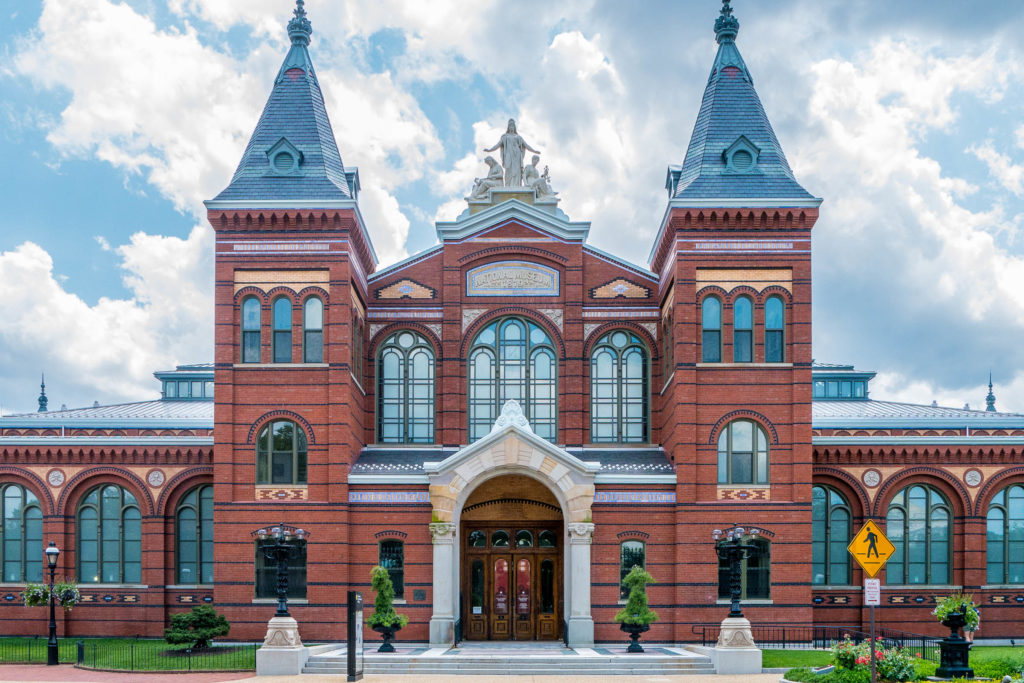
The Arts and Industries Building is a 258,000-square-foot Victorian redbrick structure located beside the Smithsonian Castle. Opened in 1881 as the United States National Museum, it was the first Smithsonian building specifically designed as a public museum and eventually helped incubate collections that became part of several major Smithsonian institutions.
The choice is strategically important because the Smithsonian already owns the building.
In 2022, the institution had recommended two undeveloped sites near the Washington Monument for the Latino museum and the Smithsonian American Women’s History Museum. Those locations are controlled by the National Park Service and lie within a protected portion of the National Mall where new construction requires congressional authorization.
By moving the Latino museum into an existing Smithsonian property, the Board of Regents can proceed without waiting for lawmakers to approve one of those sites.
That distinction has become increasingly important because political disagreements in Congress have complicated the future of both museums.
Earlier this year, legislation intended to advance the Women’s History Museum failed in the House after Republicans added provisions concerning how transgender women could be represented and giving President Donald Trump greater authority over the museum’s location. Democrats withdrew their support, leaving that museum’s permanent home unresolved.
The Latino museum has faced its own political pressures.
Trump’s proposed 2026 budget sought to eliminate separate funding for the standalone museum and instead distribute Latino programming across other Smithsonian institutions. The proposal encountered opposition not only from Democrats but also from Republican members of the Congressional Hispanic Conference.
Conservative lawmakers and organizations have also criticized some of the museum’s programming. Its first physical exhibition, “¡Presente! A Latino History of the United States,” addressed subjects including immigration, LGBTQ rights and criminal justice reform while highlighting prominent Latino figures such as Celia Cruz and Roberto Clemente. Critics argued that portions of the exhibition presented Latino history through an overly ideological framework.
The decision to use Arts and Industries therefore gives the museum greater certainty at a politically complicated moment.
Museum director Jorge Zamanillo described the selection as a major milestone in an effort that has taken decades, saying that placing Latino history at the center of the National Mall would integrate the Latino experience more directly into America’s national story.
The building itself presents both opportunities and challenges.
Arts and Industries closed in 2004 because of structural problems and underwent an extensive renovation lasting nearly 12 years. Its large halls, dramatic ceilings and skylights were not originally designed for modern museum exhibitions, meaning substantial additional work will probably be necessary before it can accommodate a permanent national museum.
The Smithsonian has not yet announced the renovation cost or an opening date.
Choosing an existing building also means giving up the opportunity—at least under the current plan—to create a completely new architectural landmark specifically designed around Latino history and culture. Supporters had previously envisioned a purpose-built museum similar in symbolic importance to the National Museum of African American History and Culture.
But constructing a new Smithsonian museum can take more than a decade, and congressional approval was far from guaranteed.
For supporters, securing a permanent home now appears more important than waiting indefinitely for a new building.
The decision ultimately transforms one of the Smithsonian’s oldest structures into the future home of one of its newest institutions. A building that once introduced Americans to emerging technologies, scientific discoveries and national collections will now be reinvented to tell the history, culture and contributions of Latinos in the United States.
After decades of advocacy and years of uncertainty over where the museum would be built, the National Museum of the American Latino finally has something essential: a permanent address on the National Mall.