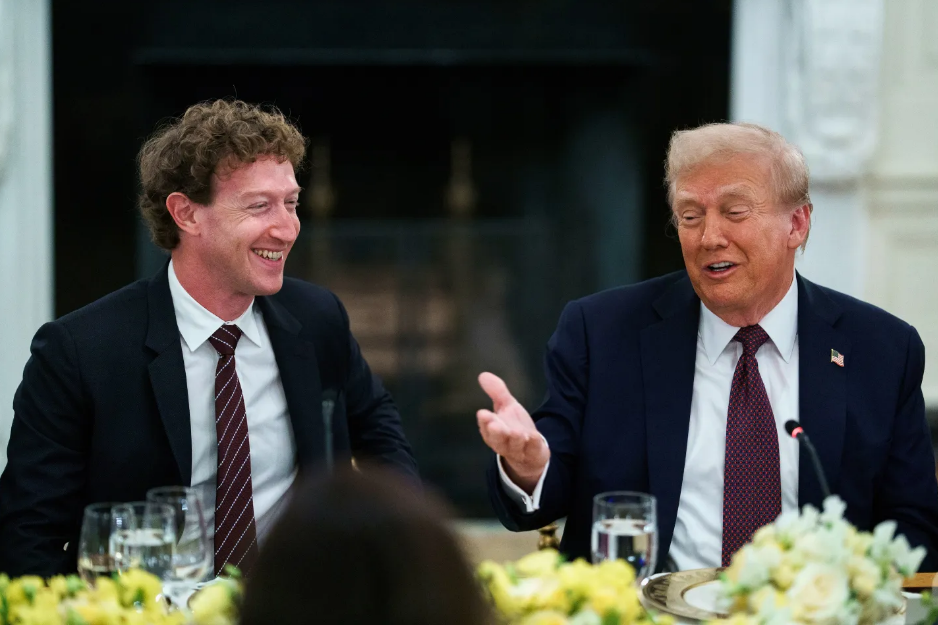
President Donald Trump has named several of the most influential figures in the technology industry to a newly structured White House science and technology council, signaling how central artificial intelligence and innovation policy have become to his administration’s agenda. The first group of appointments includes Meta CEO Mark Zuckerberg, Oracle Executive Chairman Larry Ellison and Nvidia CEO Jensen Huang, along with Google co-founder Sergey Brin and AMD CEO Lisa Su. They are part of the initial 13 industry members chosen for the President’s Council of Advisors on Science and Technology, known as PCAST.
The move reflects Trump’s broader effort to place U.S. leadership in artificial intelligence at the center of national strategy. The administration sees AI not just as a business opportunity, but as a crucial field of geopolitical competition, especially against China. That framing has shaped Trump’s second-term technology approach, with the White House pushing policies meant to speed up innovation, reduce regulatory obstacles and strengthen America’s global position in advanced technologies.
The council is expected to play a major role in advising the administration on artificial intelligence policy and related science and technology issues. The group may eventually expand to as many as 24 members, suggesting that the White House intends for it to become a broad and influential platform for shaping policy. The council will be co-chaired by White House AI and crypto czar David Sacks and technology adviser Michael Kratsios, both of whom are already key figures in Trump’s effort to align federal policy with rapid private-sector growth in emerging technologies.
The appointments also highlight a closer relationship between the administration and some of the country’s largest technology companies. The latest selections signal increasing alignment between the White House and major corporate leaders at a time when AI investment is accelerating across the economy. Zuckerberg and Nvidia said the council would help strengthen the United States’ position in artificial intelligence, while Oracle declined to comment. Alphabet and AMD did not immediately respond.
Beyond the big names from Silicon Valley, the first batch of appointees also includes Bob Mumgaard, the CEO and co-founder of Commonwealth Fusion Systems. His inclusion suggests that the administration’s science and technology agenda may extend beyond AI into other strategic sectors such as advanced energy. Commonwealth Fusion Systems described his appointment as an important sign of federal support for the fusion industry, which many investors and policymakers see as a possible long-term breakthrough in clean energy.
More broadly, these appointments come during a period of enormous spending on artificial intelligence infrastructure and services. AI has become a major driver of U.S. investment, with companies pledging trillions of dollars in future spending as the administration encourages faster growth in the sector. In that context, the new council appears designed to give Trump direct input from some of the most powerful executives in technology while helping Washington respond to increasingly intense global competition. Altogether, the council marks another step in tying American tech leadership, industrial investment and national policy more closely together.