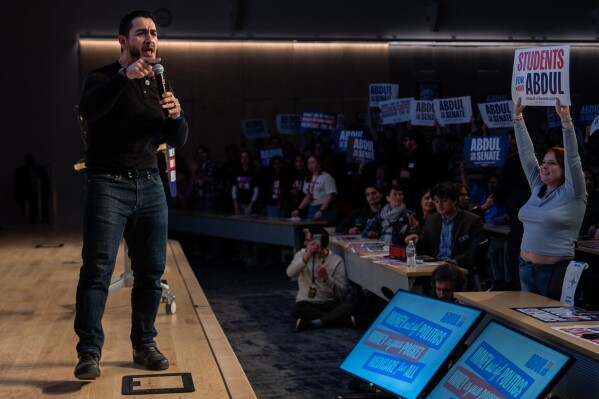
A campaign rally in Ann Arbor, Michigan, offered a revealing snapshot of how many younger voters are approaching the 2026 midterms: not with apathy, but with deep frustration toward both major political parties and a search for candidates who feel more authentic, urgent, and disruptive. Longtime Democratic Representative Debbie Dingell attended an event at the University of Michigan featuring progressive Senate candidate Abdul El-Sayed and online streamer Hasan Piker. What caught her attention was not just the speakers, but the turnout. Hundreds of mostly young people lined up outside in the cold, suggesting that political energy among younger voters remains strong, even if their loyalty to the Democratic Party does not.
This generation has come of age politically during the Trump era, and that experience has shaped a more cynical and emotionally exhausted view of politics. Seemingly, young attendees described a climate of constant conflict, negativity, and disappointment. One high school senior from Oakland County said many of his peers feel they have “lost hope” in tangible change, while others described current politics as exhausting and unserious. But that disillusionment is not translating into withdrawal. Instead, many young voters still show up, wait in line, and engage — just with much less trust in traditional party structures.
That distinction is central to the story. Younger adults are more likely than older Americans to view both the Republican and Democratic parties unfavorably. Also, Gallup data shows that more than half of Generation Z and Millennials identify as independents, unlike older generations, who still mostly align with one of the two major parties. That helps explain why the mood at El-Sayed’s event was not conventionally partisan. Many attendees were drawn to him not simply because he is a Democrat, but because they see him as a break from what they view as stale, overly cautious, or corporate-driven politics.
Democratic Party has failed to understand how much politics changed after Donald Trump. One attendee said Democrats were trying to preserve a pre-Trump version of the party that no longer exists. Another said the party feels complicit or inactive in the face of current crises. For these voters, the problem is not only Republican politics. It is also a Democratic establishment they see as too passive, too cautious, and too disconnected from material concerns like affordability and everyday economic pressure. That sense of alienation appears to be creating an opening for progressive candidates who speak more directly and emotionally to young voters’ frustrations.
El-Sayed’s appearance with Hasan Piker highlighted the kind of coalition Democrats are now testing. Piker is popular with younger online audiences but also deeply controversial, and he has made inflammatory remarks in the past. Yet some attendees brushed that aside, arguing that flawed figures who can capture attention and speak to their anger still feel more compelling than the party’s usual messengers. That does not necessarily mean young voters embrace everything such figures say. It suggests they are hungry for voices that sound less scripted and more in touch with the emotional reality of their generation.
At the same time, Dingell, who has seen political surges come and go, wondered whether the event reflected a durable connection or simply something exciting for students to attend. Progressive candidates have often generated enthusiasm without consistently converting it into victories, including El-Sayed’s own unsuccessful 2018 gubernatorial primary run and Bernie Sanders’ past presidential campaigns. Still, some Democrats believe this cycle may be different, pointing to recent progressive wins in New York and New Jersey as signs that anti-establishment energy may now be stronger and more electorally viable.
In the end, political challenge for Democrats is no longer merely turnout. Many young voters are still paying attention. The harder question is whether the party can persuade them that it represents real change rather than managed disappointment. The Michigan rally showed that frustration among young people is intense, but it also showed that frustration can still produce excitement, crowds, and possibility when a candidate seems to break from business as usual.