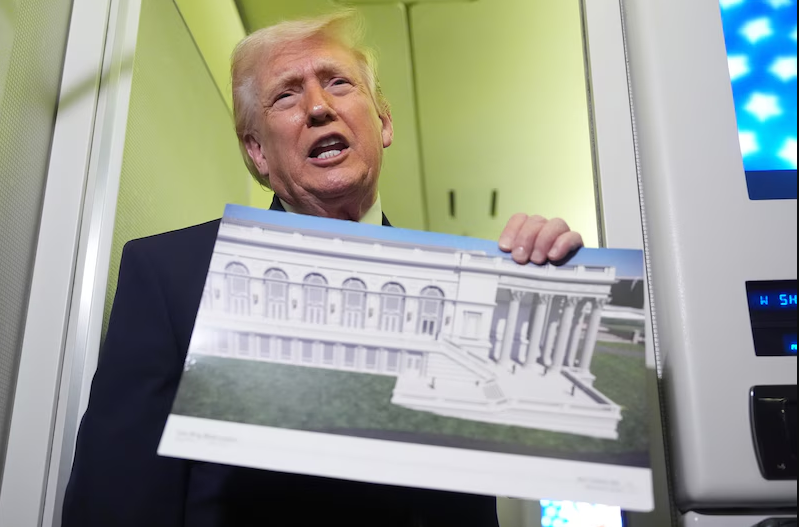
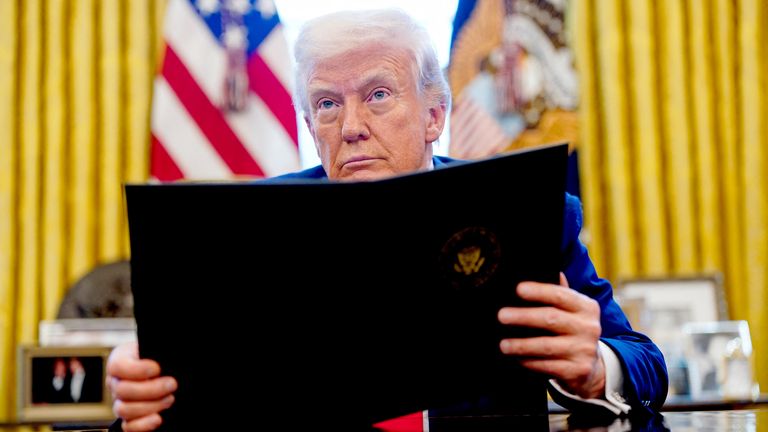
President Donald Trump made history on April 1, by becoming the first sitting U.S. president to attend oral arguments at the Supreme Court. His visit centered on one of the most controversial policies of his current term: an executive order signed on his first day back in office that seeks to limit birthright citizenship for certain children born in the United States. Trump sat in the first row of the public section of the courtroom and remained for a little more than an hour and a half before quietly leaving while lawyers for the challengers were presenting their case.
The hearing focused on the legality of Trump’s directive, which instructs U.S. agencies not to recognize citizenship for children born in the country if neither parent is an American citizen or a lawful permanent resident. That policy was blocked by a lower court, and the Supreme Court is now reviewing the dispute in a case identified as Trump v. Barbara. During the arguments, several justices appeared skeptical of Trump’s position, although the court is not expected to issue a final ruling until the end of June.
Trump’s appearance carried symbolic and political weight well beyond the legal questions in the case. He traveled from the White House by motorcade, arrived before the session in a dark suit and red tie, and took his seat beside White House Counsel David Warrington. Commerce Secretary Howard Lutnick and Attorney General Pamela Bondi were also seated in the same row. Chief Justice John Roberts did not acknowledge Trump’s presence before the hearing began, and the usual opening ceremony proceeded as normal with the court marshal’s traditional “Oyez! Oyez! Oyez!” announcement. Also, there appeared to be more security than usual in the courtroom.
Outside the courthouse, demonstrators gathered with anti-Trump signs while the case proceeded inside. The arguments lasted more than two hours, and after returning to the White House, Trump defended his position in a social media post, writing that the United States was wrong to continue allowing automatic birthright citizenship. The United States is one of 33 countries with automatic birthright citizenship, citing Pew Research Center data. Critics described Trump’s directive as plainly unconstitutional and rooted in discriminatory anti-immigrant views.
The case unfolded against the backdrop of Trump’s increasingly tense relationship with the judiciary, including the Supreme Court itself. Since the court ruled against him on February 20 in a major case involving the sweeping global tariffs he imposed last year, Trump has repeatedly attacked the justices who joined that decision. Three conservative justices — Chief Justice Roberts, Neil Gorsuch, and Amy Coney Barrett — sided with the court’s three liberals in the tariffs case, prompting Trump to lash out publicly, calling some of them “an embarrassment to their families” and later saying that Gorsuch and Barrett “sicken me.”
That context made Trump’s attendance especially striking. On one hand, the Supreme Court has backed parts of his agenda in several emergency rulings since he returned to office, including on immigration, layoffs, foreign aid, the Education Department, and transgender military service. On the other hand, this birthright citizenship case concerns a policy that tests the limits of executive power and the meaning of the Constitution’s citizenship guarantee. The hearing was not just a legal milestone, but also a rare public encounter between a sitting president and a court he has both relied on and fiercely criticized.