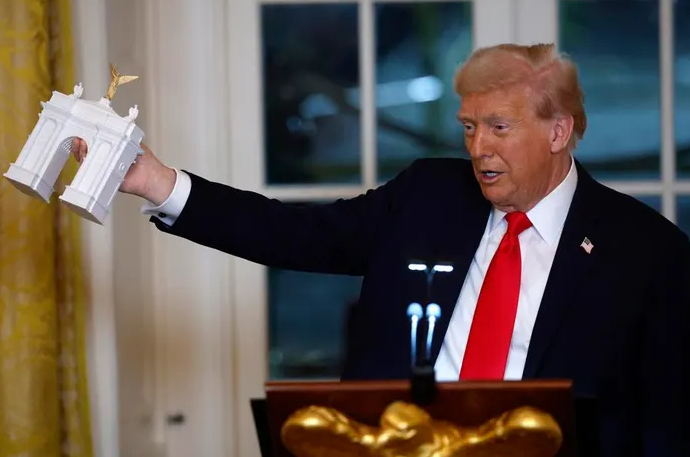
A federal judge is raising serious questions about President Donald Trump’s plan to build a large “Independence Arch” near the National Mall, adding another legal obstacle to one of the administration’s most visible symbolic projects. U.S. District Judge Tanya Chutkan sharply questioned whether Trump has the authority to move forward with such a major monument without clear approval from Congress and full compliance with federal procedures. The case was brought by Washington-area residents who argue that construction would cause lasting damage to a protected historic landscape in the center of the capital.
The proposed arch would be about 250 feet tall, making it larger than both the Lincoln Memorial and Paris’s Arc de Triomphe. The administration has suggested it wants the project completed in time for the nation’s 250th anniversary this summer, a timeline that appeared to concern the judge. Chutkan pointed to Trump’s own public statements and White House comments indicating that the president fully intends to get his arch built soon. She contrasted those statements with a sworn declaration from a federal official saying the project is still only in a “conceptual stage.” That discrepancy became a central issue during the hearing.
Chutkan repeatedly pressed the Justice Department lawyer representing the government on whether the court should ignore Trump’s public remarks and instead rely only on the formal position of the National Park Service, which oversees the land where the monument would be located. The judge did not issue an immediate ruling on whether to block the project, but she clearly signaled skepticism. She ordered the government and the plaintiffs to report back by on whether the White House will agree not to begin construction unless it first obtains National Park Service approval and complies with congressional and other legal requirements. She also said she was considering requiring a White House official to provide more information about whether permits have been sought or contracts discussed.
The lawsuit itself was filed in February and seeks to stop both planning and construction before the project can advance further. The plaintiffs argue that any major new structure on federally administered land in Washington requires congressional approval. The Justice Department has pushed back, saying Congress gave earlier authorization decades ago for large structures at the planned site and delegated power to the National Park Service to adjust their design. But Chutkan appeared doubtful that this earlier authorization could reasonably be read as covering a giant new monumental arch of the kind Trump envisions.
The hearing also comes during a broader pattern of legal conflict over Trump’s attempts to physically reshape federal landmarks. Just two days earlier, another federal judge halted construction of Trump’s planned 90,000-square-foot White House ballroom, which was being built on the site of the former East Wing after its demolition last year. That ruling has already been appealed by the administration. Taken together, the two cases suggest that courts are closely scrutinizing whether Trump can use executive power to push through high-profile building projects without meeting long-established legal and procedural requirements.
In the end, the “Independence Arch” dispute is about more than architecture. It reflects a deeper struggle over presidential power, public land, and the legal safeguards that govern changes to historic spaces in Washington. For now, the project has not begun, but the court’s questions indicate that any effort to fast-track it will face intense judicial review.